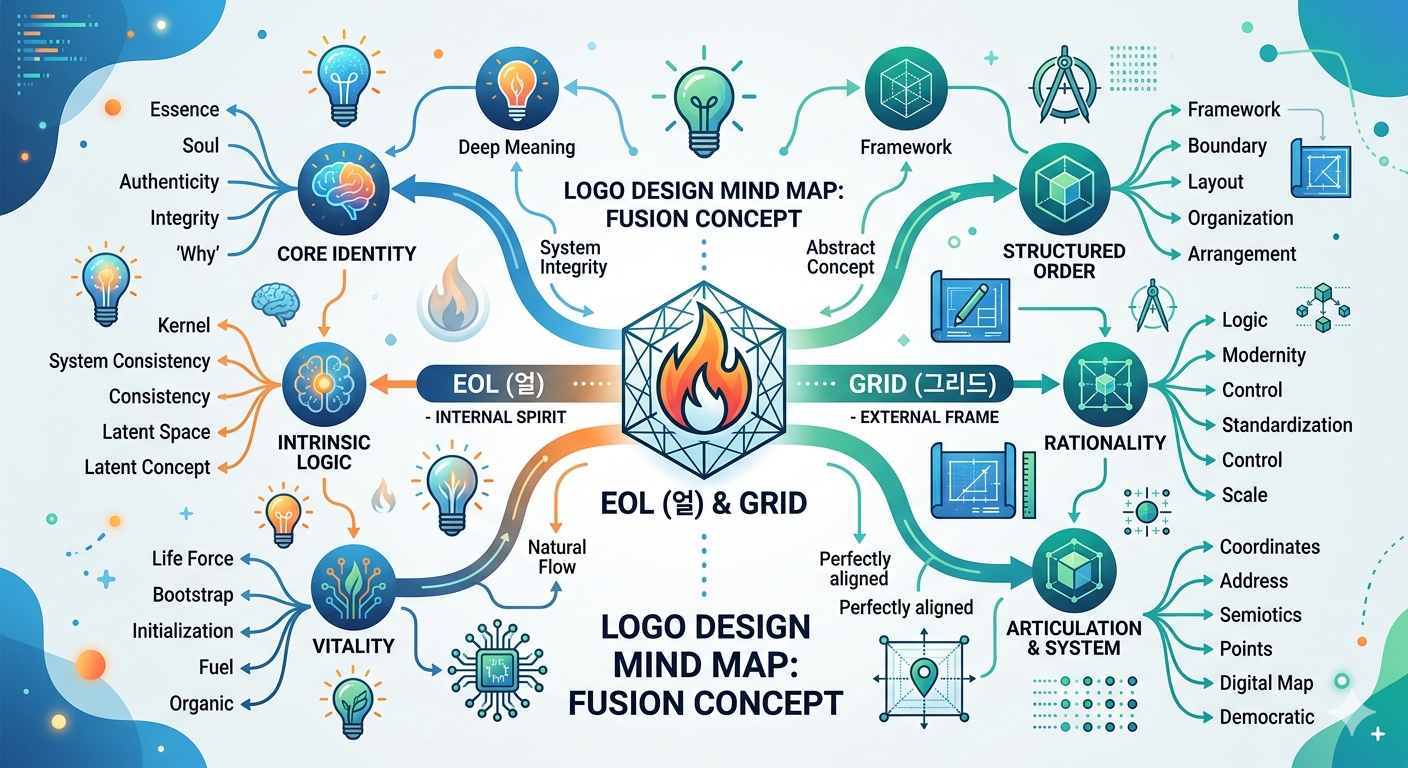
Interpreting “Eol” (얼) from a Computer Science Perspective
In Korean, “Eol” represents the core spirit or soul that defines an entity. From a systems architecture or engineering viewpoint, we can interpret this as the “Essential Logic” or “System Integrity.”
1. The OS Kernel and Abstraction
The Kernel, the core of an operating system that manages hardware-software communication, functions much like “Eol.”
- Interpretation: While the UI (the “Face”) and individual processes handle external interactions, the Kernel (the “Eol”) maintains the system’s identity and resource management. If the Kernel crashes, the system enters a “Kernel Panic”—essentially the digital equivalent of “losing one’s spirit” (얼이 빠지다).
2. State and Identity
In Distributed Systems or Object-Oriented Programming, “Eol” can be seen as the State or the Unique ID of an object.
- Interpretation: Instances (objects) in memory are ephemeral and constantly changing, but the underlying Consistency and the Blueprint (Class) that define what that object is remain constant. “Eol” is the unchanging identity that persists through myriad data processing cycles.
3. AI Weights and Latent Space
From a Modern AI/LLM perspective, “Eol” is analogous to the trained weights or the Latent Space.
- Interpretation: The text or images generated are merely outputs (the “Surface”). The true essence lies within the deep Latent Space—the condensed representation of concepts formed by trillions of parameters. This “quintessence of logic” that governs the output is the system’s “Eol.”
4. Firmware and the Bootstrap Process
“Eol” can be viewed as the Firmware or BIOS—the minimum logical unit required to transform a “hunk of metal” into a “functional entity.”
- Interpretation: No matter how powerful the CPU or RAM (the “Body”), the machine is useless without the base logic (the “Eol”) to drive it. It is the Bootstrap process that breathes life into the hardware.
Summary: “Eol” in the Systems Architecture Stack
| Category | Traditional Meaning | Computer Science Interpretation |
| Face (Eol-gul) | Physical Appearance | UI / API Endpoint (The interface for external communication) |
| Spirit (Eol) | Soul / Spirit | Core Logic / System Integrity (The essence of the system) |
| Losing Spirit | Being dazed / Out of it | Process Hang / Deadlock (Interruption of logical flow) |
| Instilling Spirit | Education / Values | Initialization / Hardening (Optimization and security baselining) |
In a technical context, “Eol” can be defined as “The unique logical framework and integrity that allows a system to function as intended.” Whether you are designing a product’s UX or architecting a complex backend, the “Eol” represents the core value and philosophy that prevents the system from becoming just a collection of dead code.
Expanding the concept of a “Grid” from a technical Data Grid into the realms of linguistics and the humanities reveals that it is much more than a layout of rows and columns. It is a symbol of how humanity perceives and organizes reality.
Here is the English translation of that interpretation:
The “Grid”: A Linguistic and Humanistic Perspective
In a technical sense, a Data Grid is an infrastructure for managing information. However, through the lens of the humanities, the Grid is a “Framework of Reason” used to deconstruct and understand a chaotic world.
1. Linguistic Approach: Articulation and Order
Etymologically, “Grid” derives from the Latin craticula (a small griddle or lattice). Linguistically, the grid acts as a tool for “Articulation.”
- Departure from Chaos: Raw data is a continuous, amorphous flow. The grid “articulates” this flow by drawing horizontal and vertical lines to create cells. This mirrors how language takes a raw stream of sound and breaks it into distinct, meaningful words.
- Coordinates and Signifiers: Every piece of data on a grid has a unique “address” (Row & Column). Just as a Signifier points to a Signified, data acquires specific meaning and context only once it is assigned a position within the coordinate system of the grid.
2. Humanistic Approach: Modernity and Control
In the humanities, the grid symbolizes the “Frame” through which humans view the world.
- The Icon of Modernity: From the perspective techniques of the Renaissance to the grid plans of modern cities, the grid represents the human will to standardize and control complex environments. A Data Grid is a product of this rationalism—bringing vast amounts of information into the human cognitive range to make it “manageable.”
- Equality and Horizontal Order: Theoretically, every cell in a grid holds the same weight and size. This represents a horizontal order, contrasting with traditional hierarchies. Within a data grid, all data points must submit to the same rules (Schema), symbolizing a democratization of information and systematic accessibility.
3. Artistic Perspective: The Invisible Structure
Art historian Rosalind Krauss famously described the grid as the “Myth of Modern Art.”
- Self-Referentiality: A grid does not necessarily describe the external world; it demonstrates a perfect internal order. Similarly, a Data Grid simplifies complex, messy business logic into an abstract lattice, forcing the viewer to focus purely on the relationships between data points rather than the noise surrounding them.
Summary: The Humanistic Definition of a Grid
| Perspective | The Meaning of the “Grid” |
| Philosophy | A “Framework of Reason” that imposes order upon disorder. |
| Sociology | A “Horizontal Space” where information is arranged equally and efficiently. |
| Semiotics | A “System” that gives data a name through position and coordinates. |
In the context of a Data Grid, the “Grid” is not merely a container. It is a “Digital Map” reflecting the human desire to conquer and comprehend a complex universe through logic.
As a designer, you might view the grid not just as a UI component, but as the creation of a “Logical Signpost” that prevents users from drowning in a sea of data.
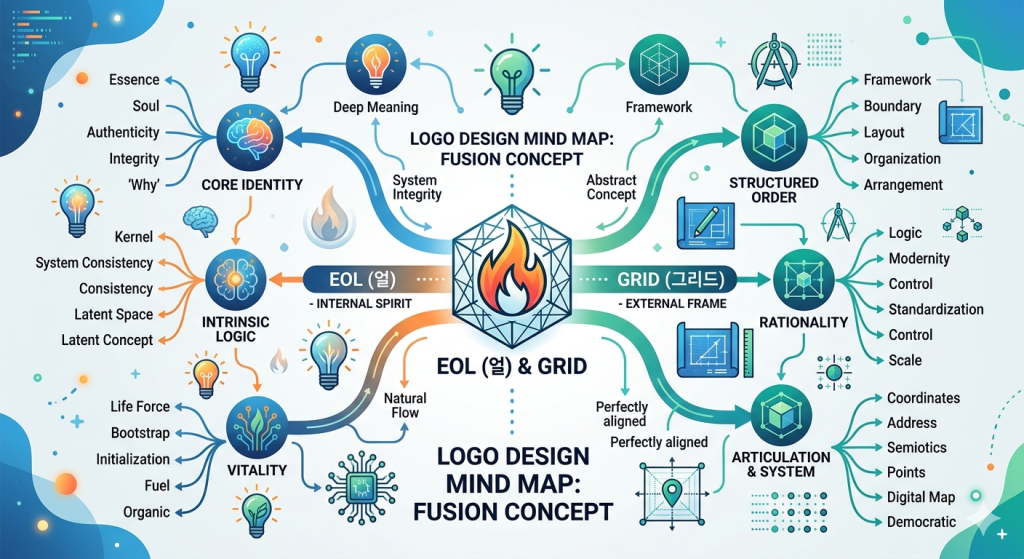
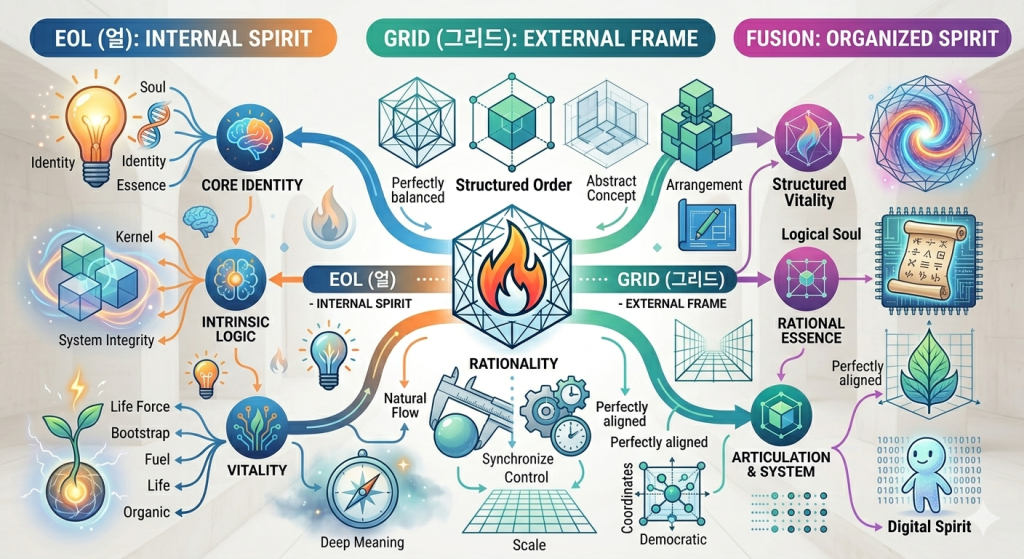
Here are the keywords extracted from the image, organized in a clear tree structure.
Keywords: Eol (얼) & Grid
- EOL (얼) – INTERNAL SPIRIT
- Core Identity
- Essence
- Soul
- Authenticity
- Integrity
- ‘Why’
- Intrinsic Logic
- Kernel
- System Consistency
- Consistency
- Latent Space
- Latent Concept
- Vitality
- Life Force
- Bootstrap
- Initialization
- Fuel
- Organic
- Deep Meaning
- System Integrity
- Natural Flow
- Core Identity
- GRID (그리드) – EXTERNAL FRAME
- Structured Order
- Framework
- Boundary
- Layout
- Organization
- Arrangement
- Rationality
- Logic
- Modernity
- Control
- Standardization
- Scale
- Articulation & System
- Coordinates
- Address
- Semiotics
- Points
- Digital Map
- Democratic
- Abstract Concept
- Perfectly Aligned
- Framework
- Structured Order
- FUSION CONCEPTS (The Intersection)
- Synthesis Goals
- Structured Vitality
- Rational Essence
- Digital Spirit
- Organized Soul
- Synthesis Goals