
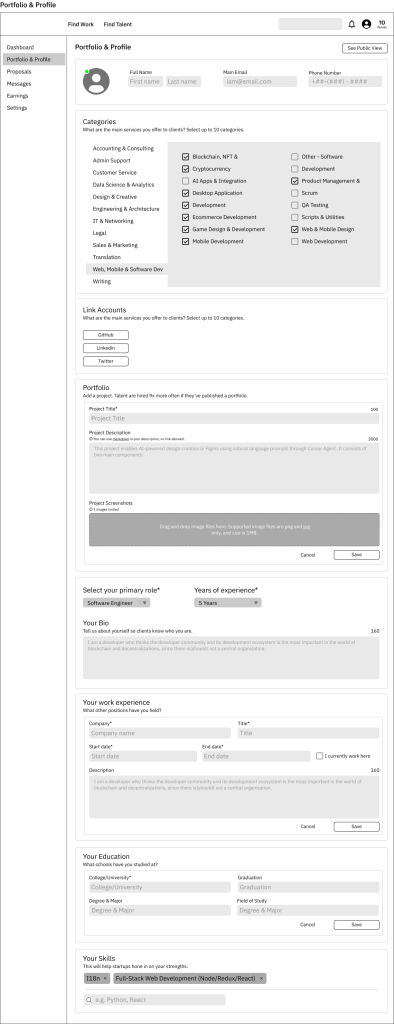
Profile & Portfolio Wireframe(for talent)
This provides a developer’s look at the “Portfolio & Profile” wireframe, explaining what I am building and why.
1. Purpose-Driven Design: Maximizing Match Accuracy
The foundation of my platform is the belief that accurate data leads to superior outcomes. I’ve designed the profile to act as a precision filter for client searches.
- Granular Service Categorization: I am moving beyond broad industry labels. The profile allows freelancers to select up to 10 specialized service categories, featuring modern fields like AI Apps & Integration, Ecommerce Development, and Blockchain, NFT & Cryptocurrency.
- What this does: It ensures that when a client searches for a “React Native Developer,” they don’t get 100 generic “Web Developers.” This specificity drastically cuts down on irrelevant applications and low-quality leads.
- The Experience/Skill Triangulation: I require freelancers to define their primary role (e.g., Software Engineer) and their years of experience. This data is then validated against their tagged skills (e.g.,
Python,Node/Redux/React). This three-point verification system gives clients confidence in a freelancer’s self-assessment.
2. Prioritizing Trust and Transparency
In the remote work ecosystem, trust is built on verifiable information. My profile is structured to make a freelancer’s history transparent and easy to review.
- The Link Accounts Imperative: I deliberately included fields for GitHub, LinkedIn, and Twitter. For developers and creatives, these links are essential.
- My Mandate: I want clients to see live code and active professional engagement, not just summarized text. This integration streamlines the client’s due diligence process.
- Verifiable History: Dedicated sections for Work Experience and Education ensure that all professional claims have a clear timeline and institutional background. This structure encourages freelancers to fully disclose their background, which I find correlates with higher job success rates.
3. Optimizing for Conversion: The Portfolio Focus
A standout feature is the emphasis on the visual portfolio. I have incorporated a critical insight directly into the user flow: “Talent are hired 9x more often if they’ve published a portfolio.”
- Intuitive Showcase: The portfolio section features a simple, drag-and-drop interface for project screenshots, title, and detailed description (with link allowance).
- My Goal: I aim to reduce the friction of uploading work. By making it easy to visually showcase projects, I anticipate a massive increase in portfolio completion rates, directly benefiting freelancers with higher conversion rates and providing clients with necessary proof-of-work.
4. The User Experience (UX) Philosophy
The profile isn’t just a database entry—it’s the core of the freelancer’s interaction with the platform.
- Scannability: I have prioritized clean, separated sections and clear formatting (as seen in the wireframe) so a client can assess a candidate in less than 60 seconds.
- Gamification for Completeness: By structuring the profile with distinct, saveable sections (Portfolio, Work Experience, Education, Skills), I encourage users to complete it incrementally. A fully-completed profile is designed to be highly rewarded within my search algorithm.
The Portfolio & Profile system is built to be the most accurate, transparent, and conversion-focused professional profile available. By demanding specificity from freelancers and providing clients with verifiable, structured data, I am confident in building a superior matching experience for everyone.