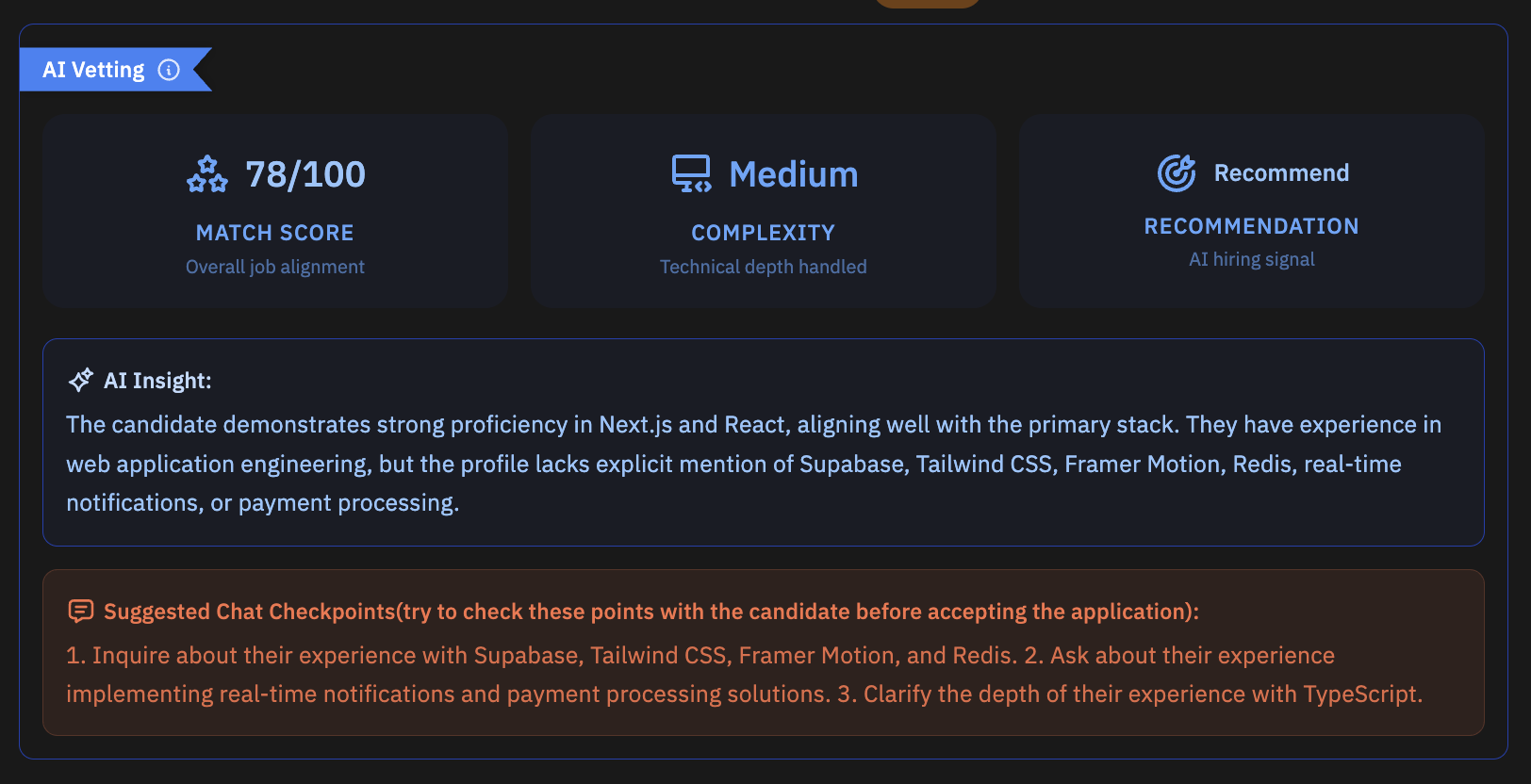
In the world of tech hiring, the “signal-to-noise” ratio is broken. Clients are often buried under piles of resumes that look identical on paper, while talented developers struggle to stand out in a sea of keyword-stuffed profiles. I decided to solve this by building a High-Signal Matchmaking Engine. It isn’t just matching “React” to “React”— it is evaluating architectural depth, code quality, and engineering maturity. Here is a look behind the curtain at how our 4-phase AI Vetting Engine works.
1. The Job Structurer: Translating Needs into Data
Most job descriptions are messy. They contain a mix of “must-haves,” “nice-to-haves,” and vague cultural goals. Our engine begins by processing these descriptions through the Job Structurer. Using LLM-powered analysis, the engine translates raw text into a strict, structured schema. It extracts:
- Primary vs. Secondary Stacks: Distinguishing between what the app is built on and what is just helpful to know.
- The Problem Domain: Identifying if the challenge is FinTech, SaaS, or high-scale Marketplace logic.
- Critical Requirements: Pinpointing specific “non-negotiables” like Stripe Connect experience or custom Auth implementations.
2. Talent Pre-Categorization: The “Capability Index”
We don’t wait for a job to be posted to understand our talent. When a developer joins and connects their GitHub or portfolio, our Talent Categorizer goes to work. Instead of trusting a self-written bio, AI vetting engine performs a deep cross-analysis of actual code quality and project history. This generates a Verified Capability Index, which includes:
- Verified Complexity Level: A proprietary metric (Low/Medium/High) that assesses the most complex architectural patterns a developer has successfully handled.
- The “Superpower”: Identifying a developer’s unique edge — whether it’s “Pixel-perfect UI” or “Database Query Optimization.”
- GitHub Signal: An objective evaluation of code consistency and ownership.
3. The Matchmaker: Context-Aware Scoring
Once a job reaches a candidate threshold, the Matchmaking Engine triggers. This isn’t a simple percentage match; it’s a weighted evaluation:
- Technical █████████████████████████████████████
- Seniority & █████████████████████████████████████
- Domain Expertise █████████████████████████████████████
The result is a █████████████████████████████████████ AI Justification explaining why the candidate was ranked that way.
4. Operational Impact: Human-in-the-Loop
I believe AI should empower human decision-making, not replace it. On the client dashboard, we provide two critical tools to finalize the hire:
- AI Insights: A summary of a candidate’s technical strengths specifically tailored to your project.
- Chat Checkpoints: The AI identifies “missing signals” or risks and generates 2-3 laser-focused technical questions for the client to ask during the interview.
Why This Matters
By moving from “Keyword Search” to “Capability Evaluation,” the system prevents mismatching where a developer might know a language but lack the depth required for a high-stakes project. The AI Vetting Engine acts as a 24/7 technical recruiter, ensuring that when a client sees a “Strongly Recommend” badge, they are looking at a developer who has already been verified for the exact complexity they are trying to build.